
Prospective students are no longer starting their journey with agents, search engines, or brochures. They are increasingly turning to AI powered chatbots to ask the questions they once asked you: "Where should I study French in the south of France?", "Which city suits me best?", "How much does it cost?", "What is the accomodation situation like?", "What is the weather like in February?", and so on.
This article, in the nicest possible way, is not about you! We're not concerned with how much you personally use, love or hate AI. The importance lies in recognising that your future students are already using it, understanding what it means for your visibility, and determining how your institution can respond.
This article explores what has changed, what you should do now, and how the future of AI will influence international education marketing. The slides are from a seminar Richard gave to delegates at ICEF Berlin in 2025.
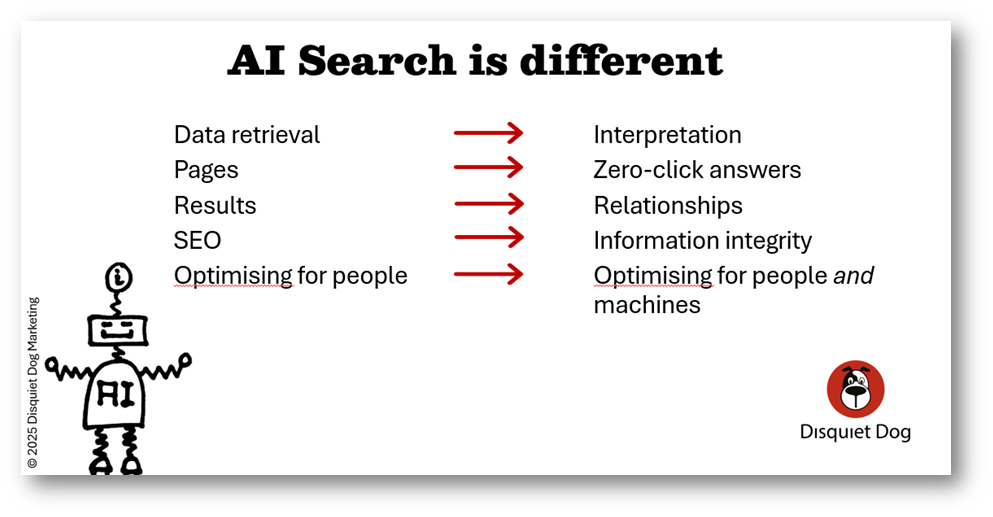
The Shift: From search engine optimisation to AI interpretation
For nearly twenty years, organisations competed for visibility on Google by optimising for search results. SEO is not dead, but its centre of gravity has moved. Instead of showing long lists of links, AI tools interpret data and offer direct, conversational answers. People ask, and the AI synthesises.
This means your organisation is no longer competing only for human attention. You are now competing for AI interpretation. The question is no longer whether your website ranks. The question is whether a chatbot can understand your organisation, your programmes, your values, and your differentiators well enough to recommend you.
Search optimisation is giving way to information integrity. Machines now evaluate whether your information is trustworthy, comprehensive, structured, consistent, and easy to interpret.
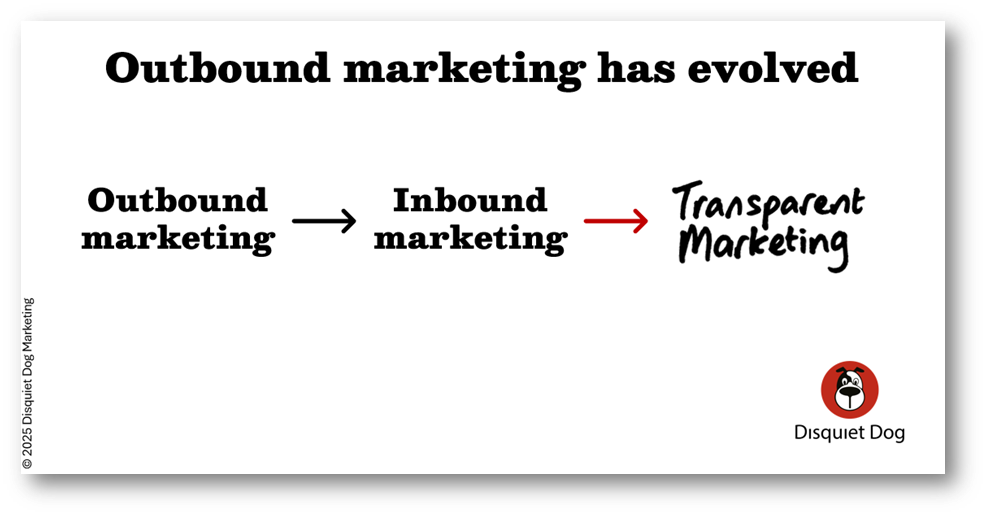
From Outbound to Inbound to Transparent marketing
Marketing has been shifting for years.
Outbound marketing involved pushing messages into inboxes and social feeds. It assumed that interrupting people would convert them. It rarely did.
Inbound marketing improved things. If an interested student searched for “intensive English courses in Eastbourne”, your goal was to appear with relevant information for that search. It still is, to be fair.
But we are now entering a third stage I'm calling transparent marketing (let's see if it catches on). AI assistants need far more detail than a typical website provides. They need depth, clarity, and structured information. Anything that is locked away in one person’s head or in a PDF on someone’s desktop will never be surfaced by an AI.
Transparent marketing means taking the knowledge embedded in your people, systems, and legacy processes and transforming it into visible, accessible, structured data that AI tools can confidently use. If you are in a role where your board is continually asking you about your strategy for succession planning, this is your opportunity for a twin-win, of prepping for AI visibility, and ensuring institutional knowledge outlives individuals.
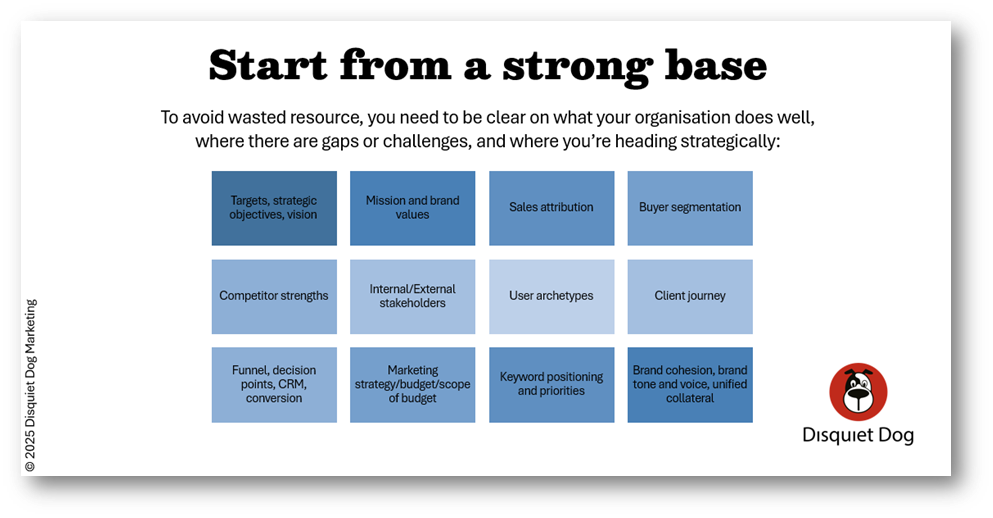
Start with marketing basics
The foundations matter more than ever. Your whole organisation should understand its mission, terminology, brand values, and audience. Content still needs to be authoritative, reliable, people centered, and accurate. AI can generate content easily, which means the value now lies in content that is distinctively yours. Your brand voice matters, and now is an excellent time to run back through the basics. If you've lost sight of your founding principles, maybe dust them off and see if you still extol the same virtues. Soulless organisations whose only purpose is to make more money and profit than last year are also at risk. Make a difference, mean something to people, stand up for something, and you'll keep attracting your tribe.
By the way, we can help with this and many other marketing basics, with our bite-sized marketing sessions on demand.
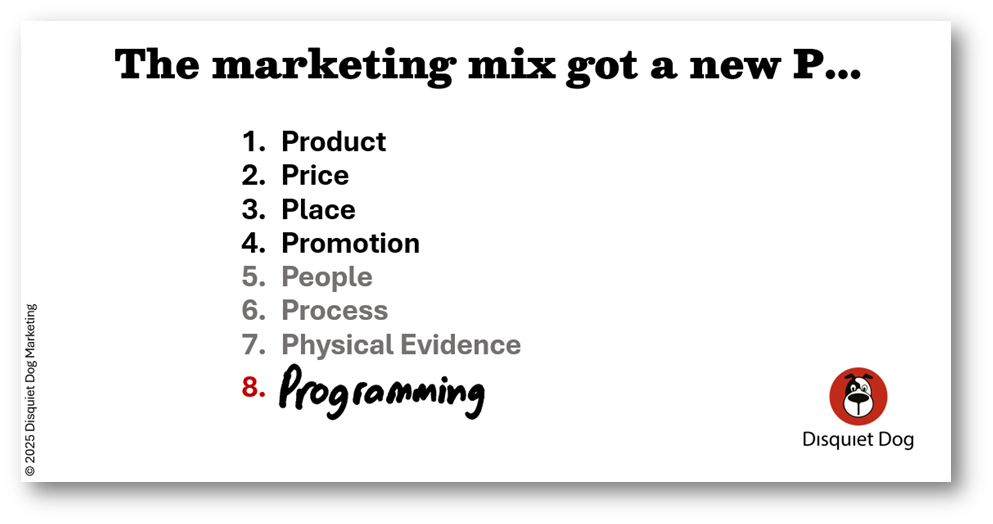
Promotion is only one part of the classic marketing mix, and in times of low student numbers, it's the P that gets hammered the most - typically through a last-minute splurge on Google Ads.
Product, price, place, people, process and physical evidence (testimonials, proof) all need renewed attention. I believe I've coined a new 'P' which needs adding into the mix: Programming.
By programming I mean building the underlying information and systems that allow AI tools to understand what you offer. It is truly another means by which to get your message out. It's quite unlike any other part of the marketing mix, and if AI continues its current trajectory in terms of how we all seek and search through life, it's going to be the most important one. You heard it here first!
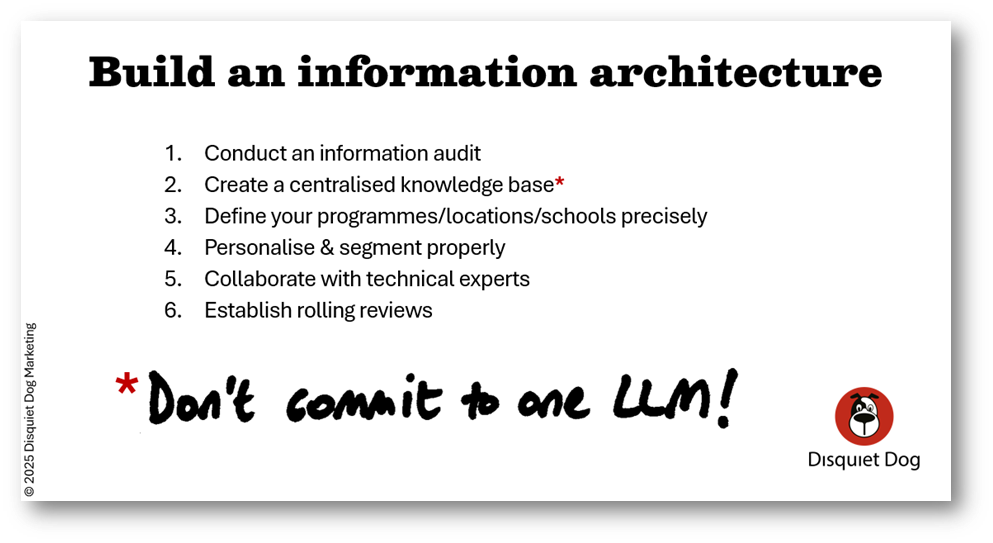
Conduct an information audit
Ask yourself what is known inside your organisation that is not yet visible to the outside world. For example:
- Where does your accommodation knowledge live?
- Who knows all the local area information that students may ask you about?
- Which quality or learning processes are understood only by specific team members?
- Which details exist only in daily conversations and not in systems?
If information lives only in your staff’s heads, an AI chatbot cannot learn it or recommend you based on it. This is not about replacing people. It is about capturing institutional knowledge so it becomes usable, shareable, and interpretable. If you ask most people working for language schools and other education providers, they'll tell you they never have the time to do the things they believe can add the most value, due to the volume of repetitive tasks needing priority attention. Offloading info to a central data bank could be the first step to getting time back for more value-adding, creative tasks.
Avoid storing your core data inside a single AI model. Hold it centrally in a place you control, so you can adapt as technology evolves.
This is our top tip, to keep your data in a system that you completely own, and regularly upload this to your current large language model (LLM) of choice, whether that's ChatGPT, Gemini, Claude, or something else. That means if you ever want to switch LLM you can do, by simply uploading all your info to a new model.**
You can use wikis, Google Docs, SharePoint, or any systematic format as long as the information is comprehensive and maintained.
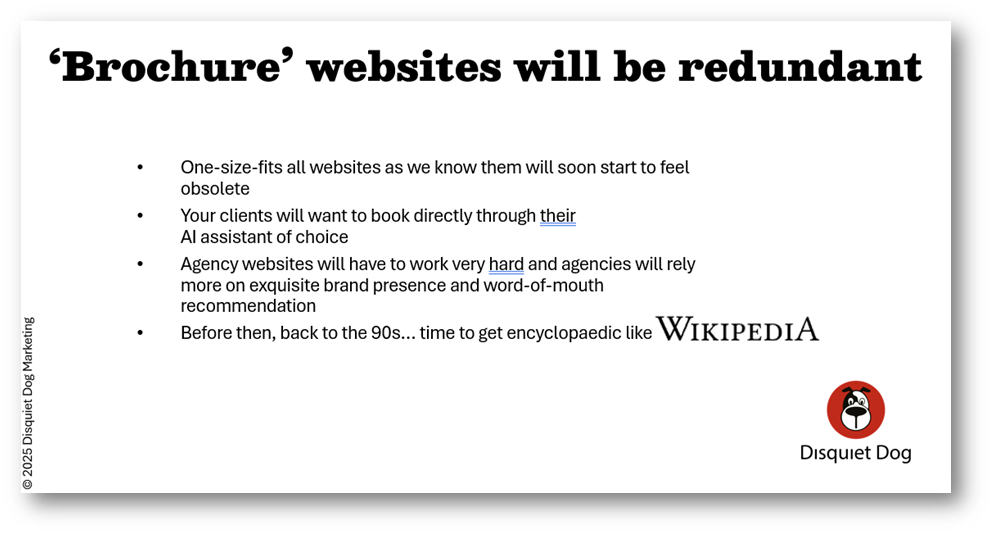
Rebuild websites for depth, not just design
For years, websites became lighter, simpler, and more visual. Large images, concise text, and storytelling dominated, and you threw away a lot of written text. At Disquiet Dog, we've always been advocates of keeping that detail somewhere. It looks like we were right. The minimalist trend still has a place - for high level landing pages and your home page, but you now need an additional layer of in-depth pages that contain all the details students require. The information once hidden in PDFs or fragmented documents must be brought into structured, accessible pages that AI tools can understand.
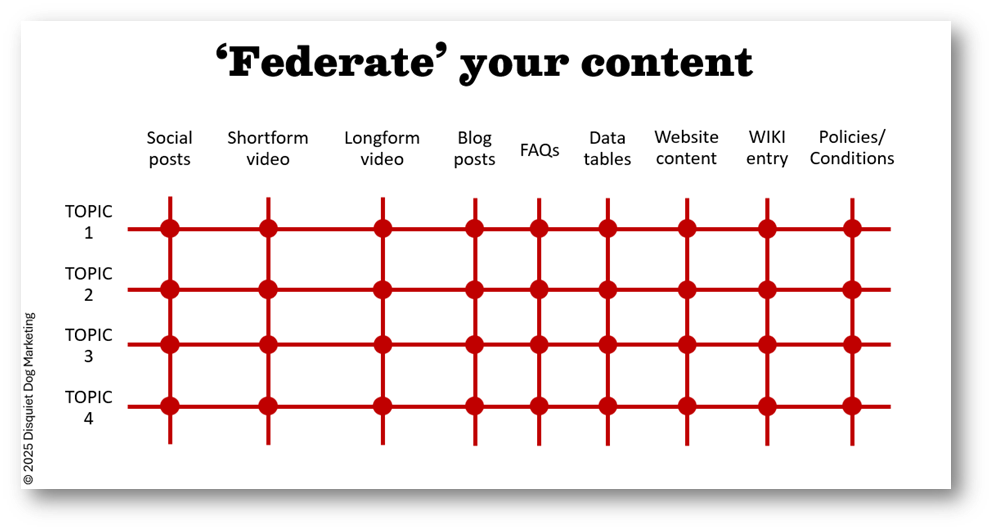
Federate your content
Most schools post lovely photos of social activities. These are useful signals of life on campus, but they are not enough. Your stories, policies, all the juicy details about your programmes and values must appear consistently across formats:
- Websites
- Social media
- Video
- Long form articles
- Knowledge bases
- Structured data feeds
Different audiences consume content differently, and AI tools now consume all of it. So the wider you cast your (relevant) content, the more you'll get picked up in AI search results.
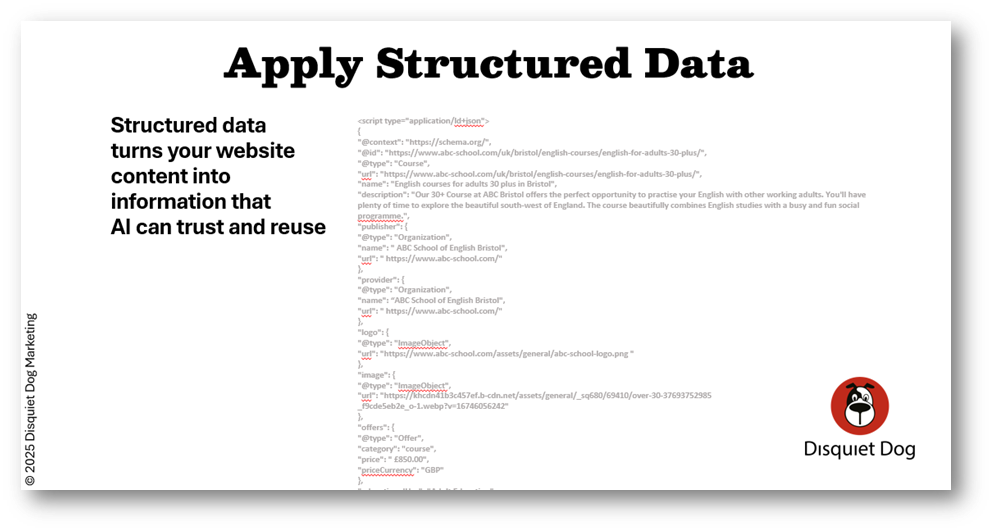
Use structured data as a priority
Structured data schema is one of the most powerful tools you can use. It involves adding code to your web pages that explicitly defines key details such as:
- Course titles
- Prices
- Start dates
- Formats
- Locations
- Requirements
This allows AI systems to categorise and index your offerings correctly. From what we have seen, applying structured data creates an almost immediate jump in organic traffic from AI systems. If you invest in one piece of external consultancy in the next 12 months, make it schema markup implementation for language schools.

The Future: Advertising, personalisation, and the return of depth
We are in a honeymoon period where AI chat tools are not heavily monetised. That will change. Advertising will become part of the AI ecosystem. Free versions of chat models may forget previous conversations. Paid versions will remember users and tailor responses.
Organisations will compete to appear in those responses. That means your data and your content matter more than ever.
Brochure style websites will fade. Shallow pages with large images and minimal detail will no longer help you. Students will book directly through their AI assistants. Agents will need to differentiate through deep qualitative knowledge and comparison, which remains their strength.
Brand integrity and advocacy will decide the winners
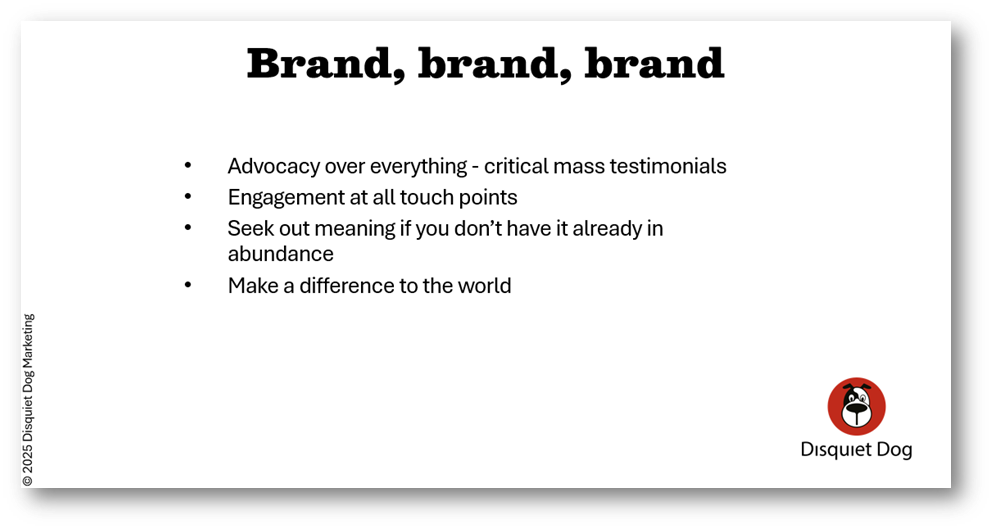
In a world where AI answers most questions, the true currency will be brand advocacy. Not impressions, not bounce rates, not abstract engagement metrics. The only thing that matters is whether people publicly recommend you, endorse you, and share positive experiences.
Students will choose organisations with soul. They will choose brands that communicate purpose, clarity, and meaning. Your founding story, your values, and your mission will matter more than ever.
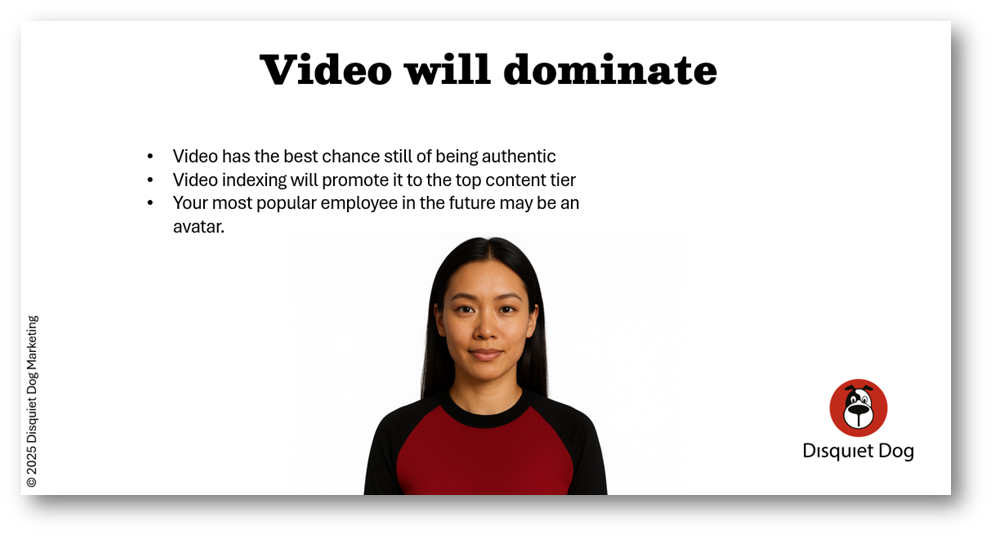
Video will become even more important as AI becomes better at understanding it. Authenticity will be a differentiator. It's already becoming more difficult to spot AI generated video content amid the real stuff, but if you apply the same principle to your video output as you do everything else, it will be infused with your brand messaging, your real voice, and it will serve your students and other stakeholders well.
In Summary
This has just been a quick skim through the actions to take if you're worried that your prospective students are talking to an AI-powered chatbot, and not to you directly.
To prepare for an AI driven future:
- Return to marketing fundamentals
- Build robust internal knowledge systems
- Shift from inbound marketing to transparent marketing
- Create a centralized database of your information
- Federate your content across formats
- Embrace video
- Prepare your website for depth and structure
- Use structured data widely
- Strengthen your brand and your authenticity.
Your prospective students are already talking to AI powered chatbots. Now is the time to ensure you are part of the conversation.

How Disquiet Dog can help
If your institution or agency is wondering how to prepare for this AI shift, we can help you turn the ideas above into action.
1. A custom talk for your organisation
Richard can provide you with a custom version of his full talk, both remotely or face-to-face as part of a sales and marketing team talk or workshop or in conjunction with a digital audit with recommendations for your organisation . Please contact us if that's something which would interest you.
2. Audit and structure your knowledge
We help you identify where your organisation’s critical information lives, what is missing, and how to make it machine-readable and human-useful. → Book a free 30-minute consultation to discuss how we can start this process together.
3. Build transparent marketing systems
We design content and data architectures so AI tools (and humans) can understand what you offer. That includes rebuilding websites for depth and clarity, and implementing structured data. → Contact us to learn how we can make your digital presence AI-ready.
4. Strengthen your brand and content integrity
From brand positioning workshops to content strategy, we help ensure everything your organisation publishes reinforces credibility, authenticity, and trust — the foundations of AI-era marketing. → Check out our bite-sized marketing sessions and let’s explore what your next steps should be.